Can you tell us who you are, what you do and what inspires you?
My name is Layla. I come from Rio de Janeiro, Brazil, and I have just finished my bachelor’s degree at the Design Academy Eindhoven. My journey in design started unexpectedly an at an early age, and through it I learned how to cultivate my creativity and critical thinking. Much of my work is about questioning the world around me as it evolves, and how I evolve alongside it.
In my final year of school, I developed a strong interest in artificial intelligence and its social impact, which eventually resulted in Glass Memory, a project exhibited at the Volkshotel. I am often inspired by questions around what it means to be human in the age of AI. However, my interest is ultimately less about the technology itself and more about the human condition and its uniqueness.
What is ‘Glass Memory?
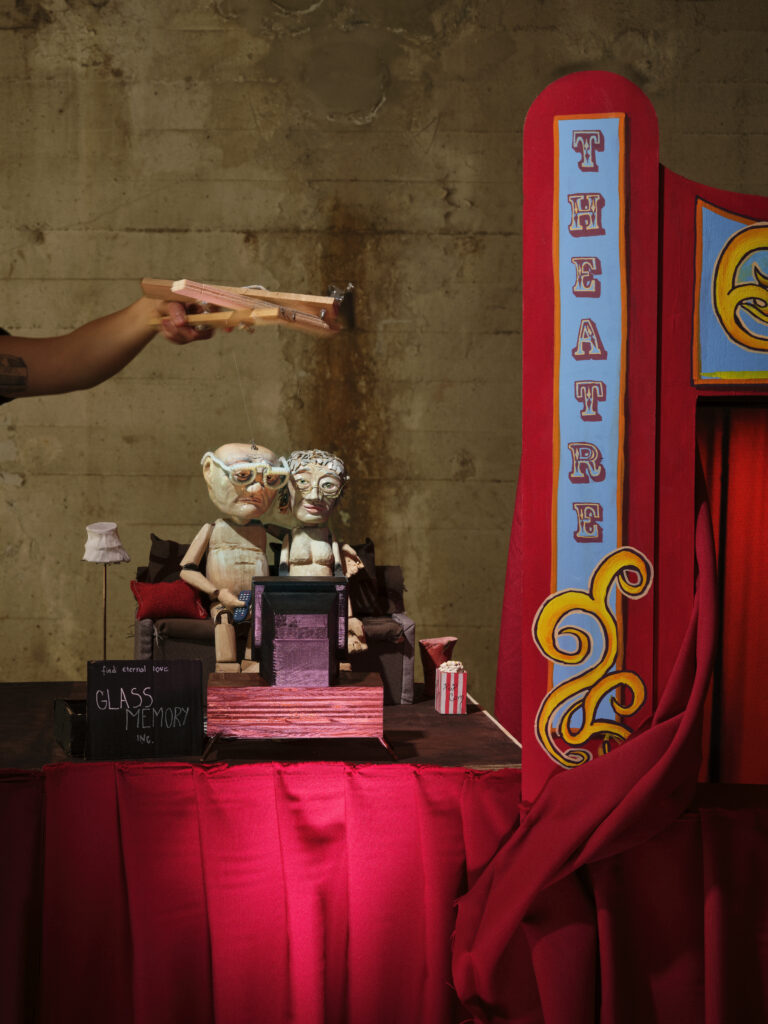
Glass Memory is a short film about connection, memory, and loss. Crafted through marionette puppetry, it explores the impactful role technology may play in shaping future human relationships. The film portrays an elderly couple’s quiet rituals and moments of intimacy; her presence is loving yet conditional by the glasses he wears. It reflects on a cultural shift toward seeking connection through technology, especially in moments of loneliness or loss. Glass Memory questions how artificial intelligence, increasingly capable of simulating human behaviour, challenges the fragility of human relationships, which are complex, imperfect, and finite by nature.
How did you approach the visual presentation of the film, and why did you choose to present it as an installation rather than a traditional screen-based work?
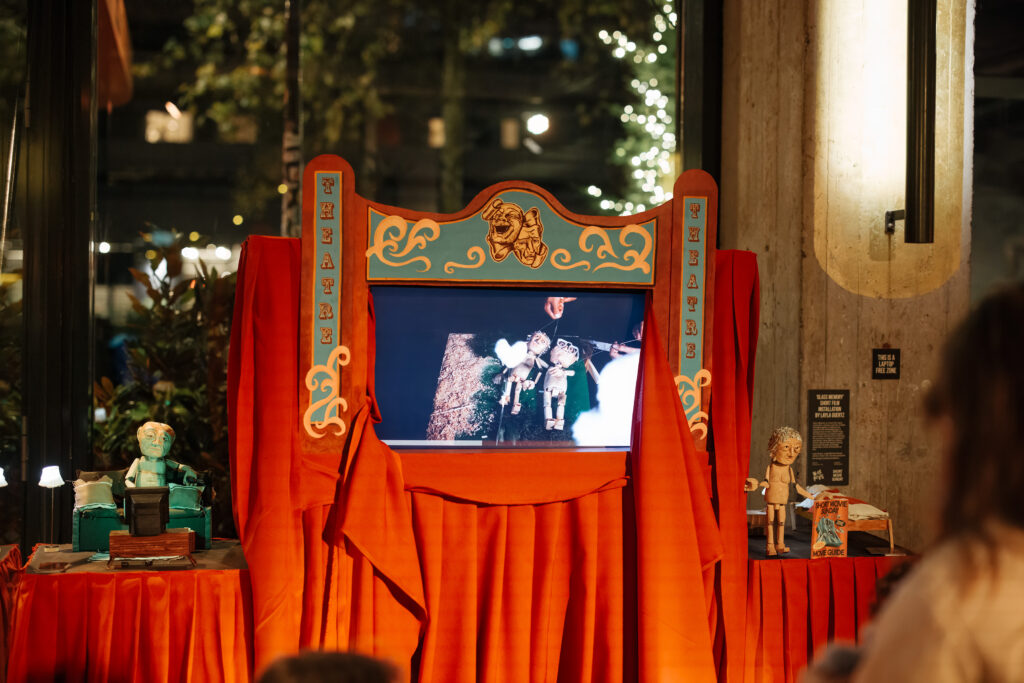
As a puppetry film, in order to replicate the magic of a puppet performance, I had to “remove” the presence of the screen. I therefore created an installation inspired by classic marionette theatre, such as Punch and Judy, giving it a vintage aesthetic, in contrast with the main topic. This format allowed me to create the sensation of a “magic box,” drawing people away from the awareness that they are ultimately looking at a screen.
Have you worked with puppetry before? What draws you to it?
This was my first time working with puppets, and I found it very challenging to learn not only how to maneuver them, but also how to build the wooden marionettes. Puppetry is a magical craft. Even when we see the hands and body of the puppeteer, we are still able to suspend our disbelief and give life to an inanimate being through our imagination. I believe there is a parallel with AI, an entity in which we also perceive life in something inanimate. This drew me to the idea of telling this story through puppets. Moreover, with marionettes, I am able to express many emotions without saying a single word. It is about feeling something uniquely human.
What themes or ideas are you interested in exploring next?
I would like to continue exploring the social impact of conversational AI through my design practice. Moreover, reflecting on what it means to be human is a question I want to keep close, and I now look for new opportunities that allow me to do so. I will also cherish my skills and interest in hands-on and conceptual work, such as marionette making, jewelry making, film and storytelling.
Be sure to keep an eye on Layla for her future work and projects:
www.laylaguertz.com
Follow Layla on: @layla.guertz